

The CHILL Rules
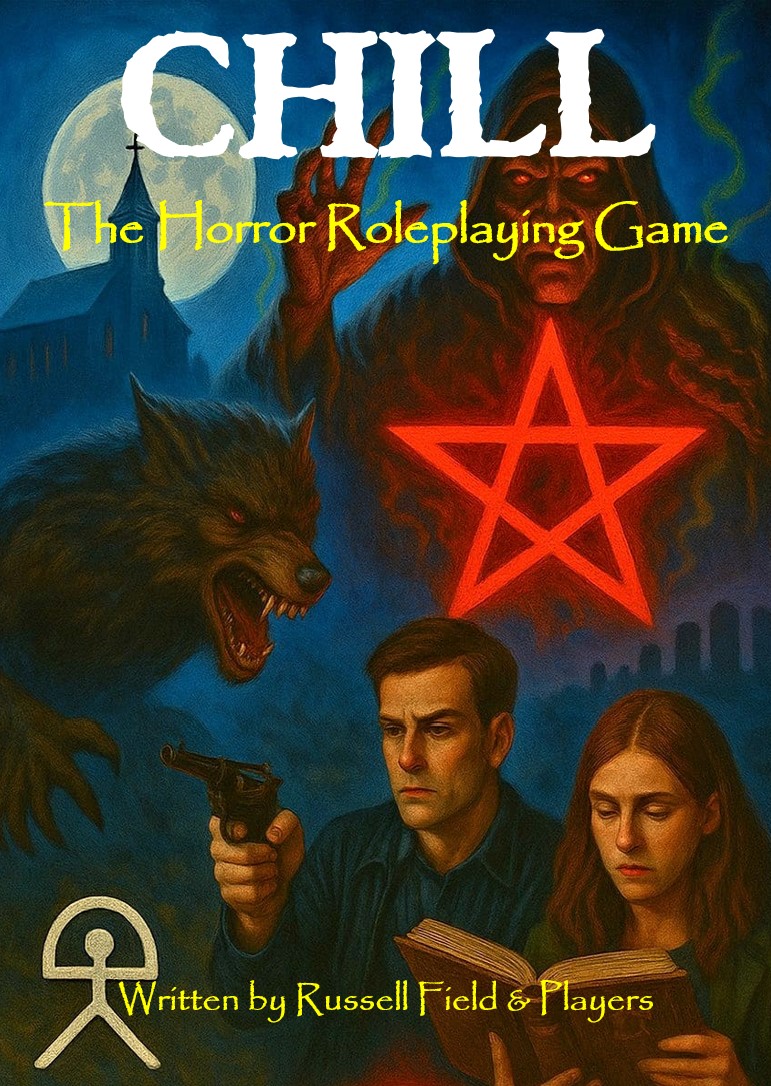
What version of CHILL is this?
This version of CHILL has been based on a hybrid of both the original systems, with extra rules stolen from various other roleplaying games. New rules have been added for magic and other aspects missing from the original versions.
These rules are a labour of love by the authors and will probably never be complete. Nor is this done for profit. These rules are to help players understand this version of the game.
Character Creation - Quick Start
Physical Description
Name. Height. Weight. Age / DOB. Sex / Gender. Nationality. Profession.
Statistics
Distribute 100 points between the following statistics: (Min: 6 Max: 16)
| Body | Mind |
| Agility (AGL) | Charisma (CHA) |
| Constitution (CON) | Intelligence (INT) |
| Dexterity (DEX) | Perception (PER) |
| Strength (STR) | Willpower (WPR) |
Special Stats
As well as the above, there is also Luck (LUCK), Sanity (SAN) and Psyche (PSY).
- LUCK starts at 12. You can take points from normal stats to increase starting LUCK.
- SAN starts at 16 (Very Stable) or lower if preferred, minimum 11 (Just Stable).
- Psyche (PSY) starts at 6 and that's for psychic abilities. The Chill Master will talk to you about this.
Skills
- Use 70 points to buy skills.
- Dodge and Brawl come free at level 0.
- 1 point gets a new skill at Level 0.
- 1 point adds a level to a skill, up to 10.
- So 11 points to get a new at level 10.
- Levels 0-2 = Novice.
- Levels 3-5 = Student.
- Levels 6-9 = Teacher.
- Levels 10+ = Master.
- Base in a skill is the average of the stats that it is based on.
Example
A character with 10 DEX and 12 PER has the Handgun skill, which based on those stats. His base chance in the skill is the average, 11. He then gets 3 levels in the skill.
Handgun (DEX PER): Base 11 + 3 levels = 14 (Skill Number). When firing a gun, the character would roll a d20 and look to get 14 or less.
Skill Number can go over 20. How much you make the roll by is important in this game.
Edges and Drawbacks
- Edge - an advantage that your character has.
- Drawback - a disadvantage that your character has.
- Every character must start with one phobia Drawback.
- Some only have 1 level. You have it or you don't.
- Others have levels, showing power level.
- Cost neutal. Edges cost points. Drawbacks give back points. Net cost should be zero.
- If Drawbacks > Edges, extra points for stats or skills.
- If Edges > Drawbacks, take points from stats or skills.
Example
Phobias have a level. Represents the Fear Check level to roll against when confronted with the phobia such as when an arachnaphobia sees a spider.
Disciplines of the Art
The Art is what psychic abilities are referred to in Chill. Most characters in Chill begin with some sort of potential in this area, which grows as they are exposed to supernatural forces.
The Psyche (PSY) is "allocated" to obtain these abilities. Note though that if you wanted your character to be able to use Magic, it is usually best not to use up their psychic potential on Disciplines of the Art. Magic relies on using unallocated PSY. Helps keep a balance between the two.
It is best to talk to the Chill Master about what sort of psychic talent your character has and how it will manifest.
Core Mechanics
Dice Rolls
Originally CHILL was a percentile system, with damage and other rolls using d10s. Players would aim to roll less than their character’s skill number.
This system uses d20, but retains the need to roll under a character’s skill number to succeed. Every 5 points in the original system converts into 1 point in this system.
Skill Number
Skill number is a generic term to denote the points the character has in any skill or ability being rolled against. It is the base target number being rolled against.
Advantage / Disadvantage
The concept of advantage (roll 2d20s and take the highest) and disadvantage (roll 2d20s and take the lowest) are good one and used in this game.
General and Specific Checks
An easy task can be achieved simply by rolling equal to or less than a character’s skill number. This is called a general check.
Skill levels in CHILL can be quite high, with skills at Master rank often raising above 20. It is therefore usually important to determine how much a roll was made by. This is called a specific check and most rolls are made this way.
Contested Skill Checks
When two characters match their skills against each other, each rolls against their skill. The one that made it by more succeeded. A tie falls in the favour of the character with the higher skill number.
Levels of Success
Rolling above a character’s skill number means the attempt failed. If the margin is 5 or more above the skill number, that can be classed as a terrible failure.
If the roll is equal to or below a character’s skill number, it has succeeded, but for very difficult tasks the roll may have to be made by a certain margin in order to achieve the outcome the player desires. THe Chill Master decides how much the roll needs to be made by to succeed.
Use the table below as a general rule of thumb.
| Roll Made by | Result | Description |
|---|---|---|
| -5 or less | Terrible Failure | Things went terribly wrong for the character and their failure may result in things getting worse. |
| -1 to -4 | Failure | The skill attempt failed. |
| 0 to 4 | Limited Success | The skill attempt only just succeeded and may have cost extra resources or time in order to succeed. |
| 5 to 9 | Moderate Success | The skill attempt succeeded in a normal way. |
| 10 to 14 | High Success | The skill attempt succeeded and the character usually used less resources or it took less time. |
| 15+ | Complete Success | The skill attempt was very successful. It happened quickly with outcomes that aid the character. |
Critical Rolls
A natural roll of 1 on the dice usually indicates a special success, regardless of the skill number.
A natural roll of 20 on the dice usually indicates a special failure, regardless of the skill number.
Statistics
There are 8 main statistics, split into Body or physical stats and Mind or mental stats. They have a range from 6 (minimum) to 16 (normal maximum). There are then three special stats. LUCK and SAN follow the same range as main statistics, but PSY can increase to 100 or more.
Body
Agility (AGL) - Agility reflects a character’s ability to co-ordinate their entire body movement. It is used in activities like athletics, climbing, dodging and fighting.
Constitution (CON) - Constitution reflects how fit and healthy a character’s body is. It is used in activities like endurance, fighting off diseases and poisons and determining physically injury / hit point capacity.
Dexterity (DEX) - Dexterity reflects a character’s nimbleness of fingers and hand-to-eye co-ordination. It is used in activities like lock picking, driving and firing a ranged weapon.
Strength (STR) - Strength reflects the character’s physical strength and endurance. It is used in combat and some physical skills like swimming.
Mind
Charisma (CHA) - Charisma reflects the character’s personality, charm, wits and likeability. It is used in social interaction and other social skills.
Intelligence (INT) - Intelligence reflects the character’s intellect, logic, reason and problem-solving. It is used in a lot of academic skills.
Perception (PER) - Perception reflects the character’s eye-sight, listening and speed at noticing events around them and. It is used for skills that require good senses.
Willpower (WPR) - Willpower reflects the character’s strength of personality, determination and mental resistance. It is used in academic skills and also fear checks. Willpower is also used to make Arts and Magic abilities work. It is the most important statistic in the game.
Special
Luck (CHA) - Luck is used to determine random outcomes or lucky chance. Characters can permanently spend points of LUCK to get advance on dice rolls. LUCK points can also be awarded by the CM.
Psyche (PSY) - Psyche reflects the characters psychic potential. Characters can allocate PSY to obtain special abilities called Disciplines of the Art. Unallocated PSY is available to be used to create Magical effects. PSY increases over time, awards by the CM.
Sanity (SAN) - Sanity reflects a characters's hold on reality. It is lost when encountering mind-blasting events that cause trauma. SAN over 15 makes using Arts and Magic harder. SAN under 11 makes using Arts and Magic easier. If SAN reaches 0, the character is lost and permanently becomes an NPC.
Changing Statistics
Normal statistics rarely change, except to go up occasionally when character improve through spending Insight Points. Special statistics are much more flexible and can go up and down alot as time goes by.
Current Stamina
Derived from the CON stat, this reflects the character's hit points. This stat can change due to exhaustion and injury, but it does not affect the Constitution stat or rolls against that stat.
Current Stamina is recovered through rest. A character heals 1 point per day automatically. An extra 1 point can be healed from rest or medical attention.
Current Willpower
Derived from the WPR stat, this reflects the character's "mental" hit points and resistance to fear. This stat can change due to the negative effects of Fear Checks and using Disciplines of the Art or casting Magic. This does not affect the character's Willpower stat or rolls against that stat.
Fear Checks are rolled against a character's Current Willpower, so resisting fear gets harder as Current Willpower reduces.
Current Willpower is recovered through rest. A character recovers 2 points of willpower per hour of sleep.